
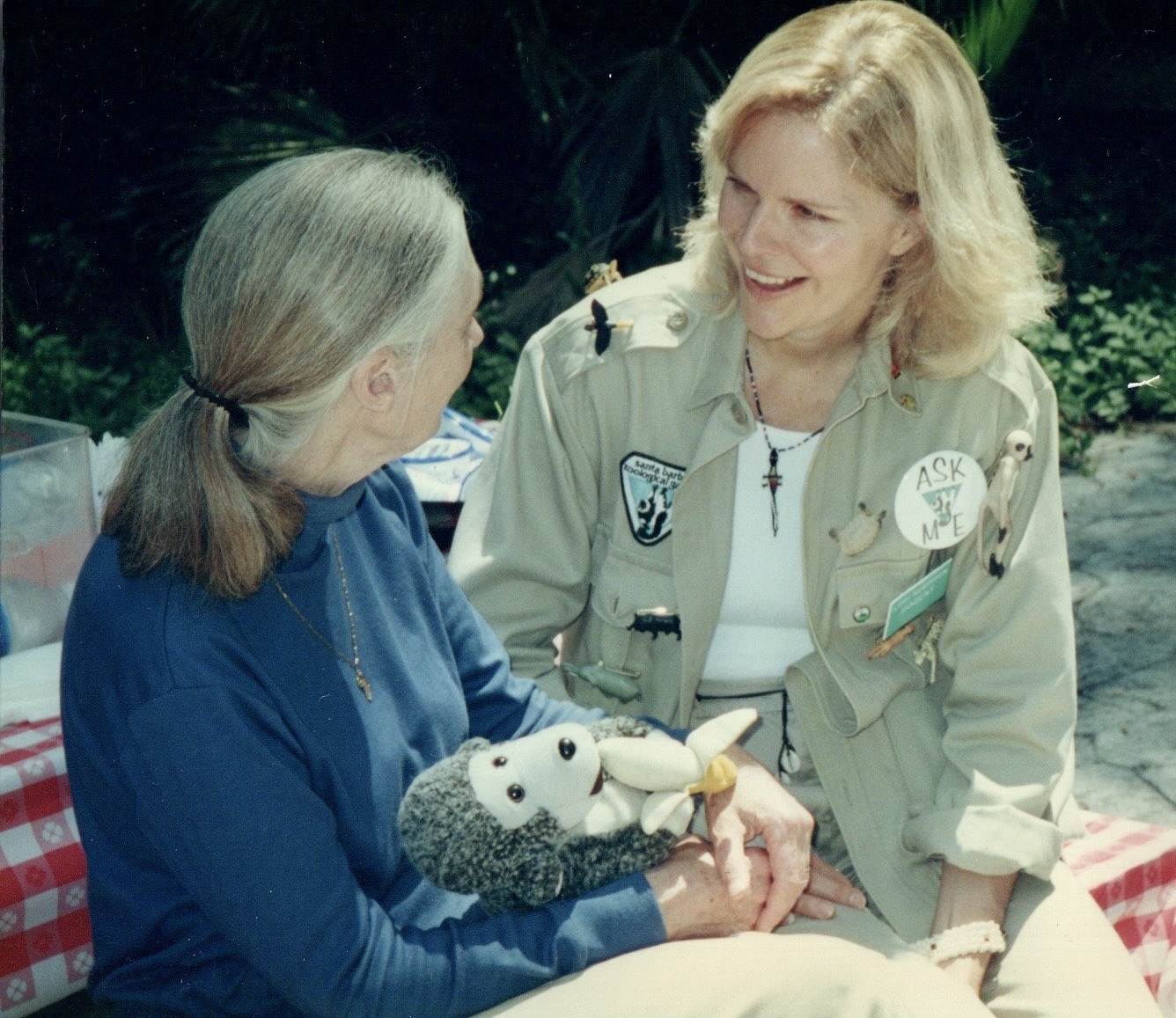
Excerpts from an interview about Jane Goodall, in which I reflect on a lifetime of knowing her. Originally published in the Montecito Journal and shared here with permission. Lori Robinson interviewed by Ann Brode.
Jane’s passing (1934-2025) has been an opportunity to tune in and remember this extraordinary woman. To get a deeper understanding of Jane Goodall and her message of hope, I spent time yesterday with my friend Lori Robinson. Lori has known and worked with Jane for over 50 years and, in many ways, is one of the luminaries carrying on her work. Here are some gems from our conversation.
Ann Brode with Lori Robinson: An Interview About Jane Goodall
I know Jane has been an enormous presence in your life. Could you recount how your life path converged with hers?
I always had a love for animals, and wanted to go to Africa. Though I had a family connection with Jane through my grandfather, it was a National Geographic article in the 1970’s that gave me a bigger picture about who she was and what she was doing. I met her in person in 1974. But, I really got to know her when I worked for her. I was always struck by how this soft-spoken woman could carry such a big, bold destiny.
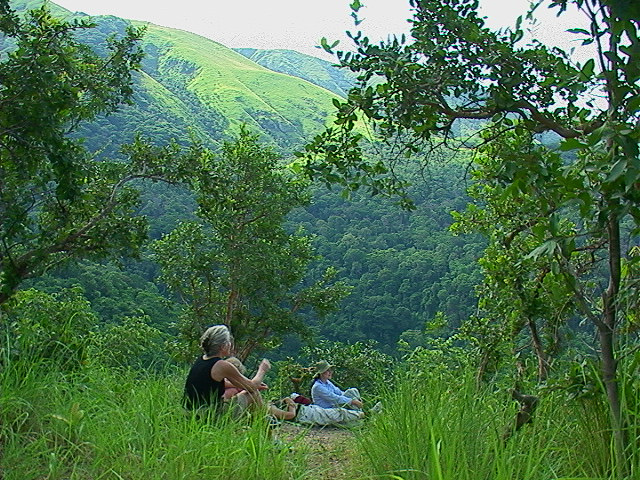
One of my first assignments with the Jane Goodall Institute was guiding a group of supporters to visit Jane’s now-famous chimps. Following her footsteps, walking the trails, trying to find the chimps for the group, I imagined Jane being in this same forest for three years as a young woman. There was a place called Jane’s Peak where she would sit for hours every day with her binoculars, looking to find the group of chimps. Sitting there, I just thought: My goodness, her patience, her dedication, her willingness!
Though Jane began as a scientist, eventually getting a PhD from Cambridge, we know her today as an eminent spokesperson for conservation and biodiversity. What influenced her shift of focus?
As local populations grew, Jane witnessed the widespread deforestation of the once-lush Gombe. As the forest got smaller and smaller, it became obvious that we needed to save the chimps’ land in order to save the chimps. So, ever on mission, Jane became a conservationist.
Through her public speaking and the work of the Jane Goodall Institute, she may be one of the most famous conservationists we know. Why is her message so resonant with so many people?
Her message was easy for people to understand because she put it simply. She had such a sweet way of presenting it. Perhaps, she learned this communication skill from her time out in nature with the chimps. She would say that in order to understand chimps or any animal, you have to sit in their world. You can’t come in aggressively. In order to connect, you need to be trustworthy. To get the message across in the world, you don’t picket and fight and blame. No. You go softly, work your way in, gain trust. Then people can listen with their heart and hear what you’re saying.
How did you work with Jane on her mission to save Mother Nature?
At first, I organized African travel safaris through the Institute where people could experience first-hand what Jane saw and understand the urgency of her message. Over and over, I witnessed how the African wilderness opened people’s perceptions and deepened their devotion to the wild and the need to preserve it. Later, I visited many Roots & Shoots programs across East Africa, speaking on behalf of Jane and her organization– praising project leaders and planting trees in barren schoolyards. On these tours, it felt as if Jane’s presence was beside me, buoying my efforts.
You’ve also designed and led travel safaris on your own, encouraging people to spend time far away from the familiar to connect with animals in the wild. How did you help people make the shift from a verbal, urban mindset to appreciate the nonverbal simplicity of the savannah?
We are a part of nature. But, the way we live our lives– with our heads, our intensity, our drive and our push –is the opposite of how you have to be in nature. If you want to connect, you have to go inside. You have to quiet yourself. It’s like a meditation but it’s not a meditation with a mantra. When you get quiet enough, still enough, your energy softens. Animals sense this and feel safe, perhaps even curious.
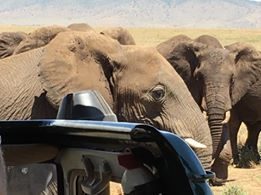
It’s really all about the energy you bring to the encounter. I’ve had experiences with elephants where I’m sitting there so quietly, and they’re literally four feet from me, when, all of a sudden, the elephants just took off running. What happened? Two minutes later, a group of people came running down the hill, shouting, “Where are the elephants? I want to see them!” The elephants felt this cacophonous energy and just got out of there.”
What a contrast between the energy of these random tourists and the energy of being still and blending with the environment. Could you offer some suggestions to help us experience this way of quietly connecting with Nature here, in Santa Barbara?
“All you need to do is find what naturalist and author Jon Young calls a “sit spot”. Let’s say in your backyard. And you go there every day, to the same spot, sitting as quietly, as still as you can. Over time, in just a few days, the animals will get used to you. And, if your energy is soft and present and not scary to them –if you’re in a place of just being and noticing–you can’t believe what starts to happen around you! It’s the same with being on safari.
Living in these contentious, self-serving times, Jane’s message can help us see the existential truth that saving Mother Nature means we save ourselves. To do this, Jane recognized the need to cultivate Hope. Without hope, we’re stuck in despair, doubt, and discord. But, with hope, we have the energy to do the important work and make a difference.
Right now, in your life, how are you channeling your hope for the future?
Because I’m not going to Africa as often, my new thing is exploring how we connect to nature and save wildlife right in our own community. One of my current mentors is Doug Tallamy, co-founder of Homegrown National Park, who urges us to get rid of lawns that do nothing for wildlife and grow native plants that do. Over the past year and a half, I’ve literally transformed the piece of land in my backyard, taking out invasive plants and replanting with as many natives as I can. As soon as I started, I couldn’t believe the number of bees, butterflies, and birds that showed up. They knew!
It’s important for each of us to find a way to make a difference. All of our issues right now feel so global and big that people are overwhelmed. But, to see the difference in your own backyard, it’s like– Wow, I am making a difference!”
When I asked Jane, near the end of her life: How do you keep going? How do you stay inspired? This woman, even in her ninth decade, anchored her gold-flecked eyes on mine and replied, “We can’t quit. We have to keep working.” Nobody and nothing deterred her goal to save Mother Nature. I think this is rare.”
Thank you so much for taking the time in this very personal moment to share your love for Jane with our community.
“It was an honor to give an interview about Jane Goodall. She was a guiding light, and I think that’s true for so many nature lovers and animal lovers, and people who get that we need to save this precious planet. I don’t know who’s going to take her place. Jane was one of a kind, and, in these times, it’s such a huge loss for the sustainability of all life on planet Earth. This makes me so sad. The truth is: We ALL need to carry on her work, each in our own way.”
Find more from Ann Brode, her books and stories, here.